A bumble bee in flight over long grass

Bioteams

High Performing Teams and Improved Collaboration through Biomimicry

Author

Ken Thompson

Ken is an expert practitioner, author and speaker on Collaboration, High Performing Teams, Change Management, Business Strategy and Leadership Development.

Gaia Theory, Covid and Bioteams

The Earth seen from space, half in shadow.

Gaia Theory, developed by the amazing James Lovelock, contends that our planet is a self-regulating system. An example of this is the incredible ability of nature to keep key variables like temperature, water salinity and CO2 within narrow upper and lower boundaries – seemingly despite whatever else happens!

Most of this happens through continuous small adjustment mechanisms which are effectively invisible to us. However over time the stress on one or more of these variables may become too great for the normal regulation mechanisms to be able to maintain the necessary equilibrium. When this happens Gaia Theory suggests that exceptional adjustments may then occur!

Continue readingGaia Theory, Covid and Bioteams
Bioteams blog relaunches with free download of The Bioteaming Manifesto

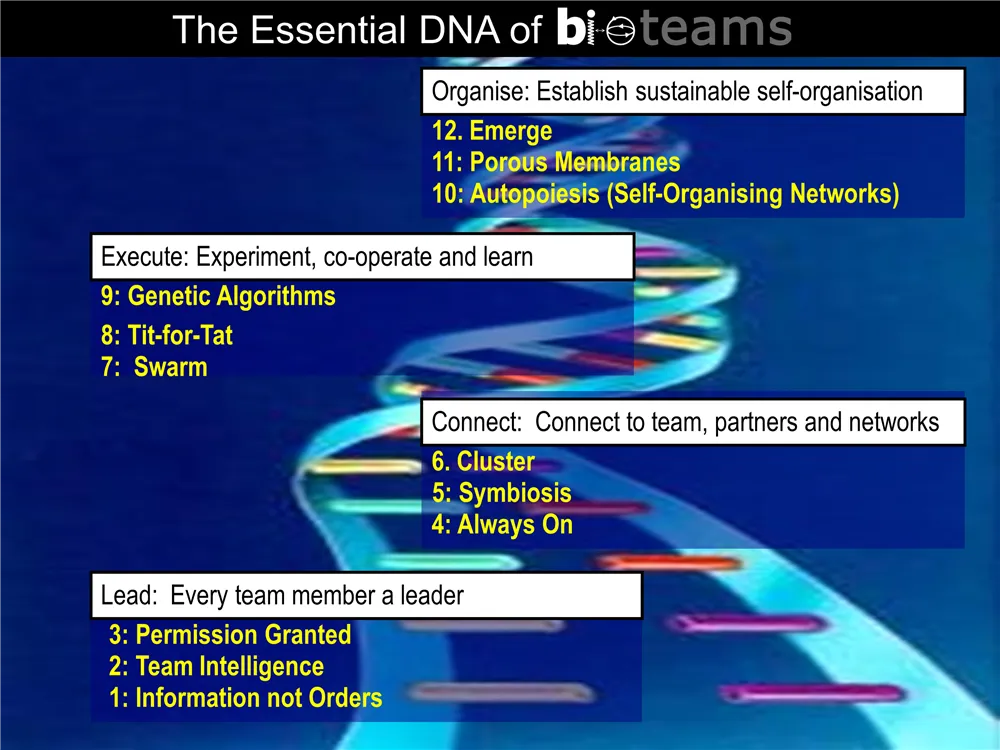
The Essential DNA of Bioteams: a DNA helix labelled with four zones — Lead, Connect, Execute and Organise — each listing three of the twelve bioteam rules, from 'Information not Orders' through to 'Emerge'.

This blog focusses on the bioteams concept – more effective teams based on nature’s proven models. If you would like a detailed overview of bioteams you can request a free copy of the 33-page Bioteaming Manifesto here.

The Bioteaming Manifesto has been downloaded 20,000 times over the last 15 years and is a very popular resource for anyone interested in the important discipline of developing and sustaining High Performing Teams.

Bioteams is structured around 4 levels of team maturity (“zones”) each of which operate around 3 guiding principles (“rules”) as shown in the diagram.

Continue readingBioteams blog relaunches with free download of The Bioteaming Manifesto

The Prisoners Dilemma, Trust, Cooperation and Effective Teams

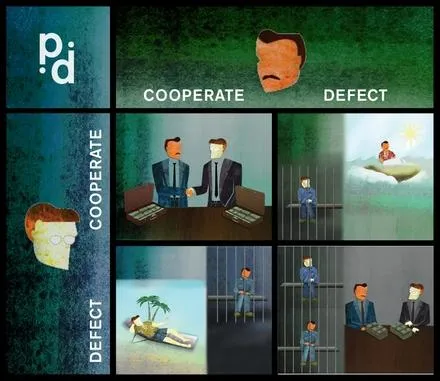
A two by two illustration of the prisoner’s dilemma: both cooperating, both defecting, and the two mixed outcomes, drawn as scenes of a handshake, a beach, and a prison cell.

Image Source: Chalkdust Magazine
I have been reading Lord Sacks daily thoughts “Celebrating Life” and was impressed by his piece on “The Prisoners Dilemma”. The Dilemma in a nutshell is that 2 prisoners are given the chance to do a deal and betray each other. 

Lord Sacks is the UK’s chief Rabbi and highlights one vital aspect of the dilemma which I had not previously paid enough attention to – the fact that the two prisoners are not allowed to speak to each other!

Continue readingThe Prisoners Dilemma, Trust, Cooperation and Effective Teams

The Superintelligent Organization: Create total competitive advantage?

I have been studying one of the most highly regarded books on the future of AI (Artificial Intelligence), “Superintelligence – paths, dangers, strategies” by Nick Bostrom. Bostrom meticulously reviews the five most likely paths to “superintelligence” which he defines “as any intellect that greatly exceeds the cognitive performance of (individual) humans in virtually all domains of interest.”

One of Bostrom’s conclusions is totally unexpected and requires immediate consideration within today’s major organizations and enterprises!

Continue readingThe Superintelligent Organization: Create total competitive advantage?

How good a team leader are you? Try my Team Leadership Assessment!

As a team leader you have two distinct leadership responsibilities – Managing the Individuals and Managing the Team. Leaders who fixate on managing the individuals tend to have happy teams which unfortunately under-perform in terms of deadlines, quality, customer satisfaction and budgets! Leaders who obsess on managing the team may hit most of these targets but at the expense of team member Alienation, Burnout, Compliance, Disinterest and eventually Exiting (easy to remember – ABCDE!). Great Team Leaders manage both responsibilities. Here is a simple framework with a nice supporting spreadsheet to help you assess and improve your leadership:

Continue readingHow good a team leader are you? Try my Team Leadership Assessment!

Free High Performing Teams Instant Healthcheck Tool Spreadsheet

An important free tool which I provide with my new book ‘A Systematic Guide to High Performing Teams‘ is a Team Process Health Check Spreadsheet written in Microsoft Excel. The spreadsheet allows you to rapidly assess each of 16 important team process elements on a scale of 0-3 ranging from ‘totally absent’ to ‘present and effective’.

Continue readingFree High Performing Teams Instant Healthcheck Tool Spreadsheet

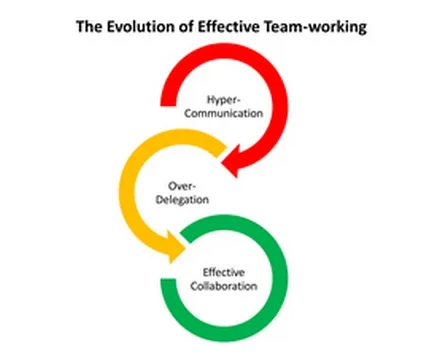
The evolution of effective team working and how you can accelerate it!

The evolution of effective team working, drawn as three linked circular arrows: hyper-communication, then over-delegation, then effective collaboration.

By observing newly formed and existing teams playing business simulations I have learned some important insights into how team-working ‘evolves’ and offer here some specific ideas on how you might accelerate this evolution in your own organizational teams.
On the road to Effective Team Collaboration there seems to be two intermediate phases of ‘naïve collaboration’ which many teams seem to go through – Hyper-Communication and Over-Delegation.

Continue readingThe evolution of effective team working and how you can accelerate it!

Top teams understand the 4 different types of Teamwork in Nature

What do we mean by “Teamwork”? We often talk about Teamwork as if its a singular thing however in nature there are 4 different types – each of which have a very precise meaning. I call these Solowork, Crowdwork, Groupwork and Teamwork itself. An effective team knows how and when to use each type – an ineffective team only uses one!

Continue readingTop teams understand the 4 different types of Teamwork in Nature

C3: a new approach to Collaborative Project Management

Most approaches to project management concentrate on the tasks which need to be successfully completed to achieve the project goal. Important as this is, it is at most only half of the story of successful project management. The C3 approach addresses the hidden side of project management – the people-collaboration-end-result perspective and is also a powerful tool for conducting a quick project healthcheck.

Continue readingC3: a new approach to Collaborative Project Management