Gaia Theory, Covid and Bioteams

Gaia Theory, developed by the amazing James Lovelock, contends that our planet is a self-regulating system. An example of this is the incredible ability of nature to keep key variables like temperature, water salinity and CO2 within narrow upper and lower boundaries – seemingly despite whatever else happens!

Most of this happens through continuous small adjustment mechanisms which are effectively invisible to us. However over time the stress on one or more of these variables may become too great for the normal regulation mechanisms to be able to maintain the necessary equilibrium. When this happens Gaia Theory suggests that exceptional adjustments may then occur!


Some believe Covid is an extreme Gaia reaction to our ever-increasing abuse of the planet. The argument runs like this:

“Humans have become an existential threat to the earth and all the creatures which depend on it. Therefore an exceptional self-regulating response was overdue to reduce (or eliminate) this threat and restore the balance.”


What does this all mean for those trying to create high performing teams?
Bioteams Rule 10 in the Bioteams Team Organization Zone is summarised in just one word – “autopoiesis”. This term refers to the well-established theory of self-organization at a biological level developed by two Chilean Biologists (Maturana and Varela).

The autopoiesis concept is explained and applied to teams in more detail here however in summary using this rule Bioteams focus on three key (but counter intuitive) core values:

  1. Making positive impacts (transformations) on key people, networks and enterprises is more important than hitting deadlines and producing artefacts and deliverables
  2. Holding relationships and collaboration as more important than processes and leadership hierarchies
  3. Constantly seeking to create virtuous cycles both inside and outside the team boundary with reinforcing feedback loops. Such a team focuses on continuous improvement and learning instead of just “getting this job done and moving on to the next job”.

Summary
A high performing team may be much more like a living creature than a well-oiled mechanism such as a beautifully engineered watch. At the bioteam’s heart is self-management. Thus bioteams learn, reinvent, repair and reproduce through a strong set of commitments, practices and values which create strong performance, resilience and agility.
Bioteams blog relaunches with free download of The Bioteaming Manifesto

This blog focusses on the bioteams concept – more effective teams based on nature’s proven models. If you would like a detailed overview of bioteams you can request a free copy of the 33-page Bioteaming Manifesto here.

The Bioteaming Manifesto has been downloaded 20,000 times over the last 15 years and is a very popular resource for anyone interested in the important discipline of developing and sustaining High Performing Teams.

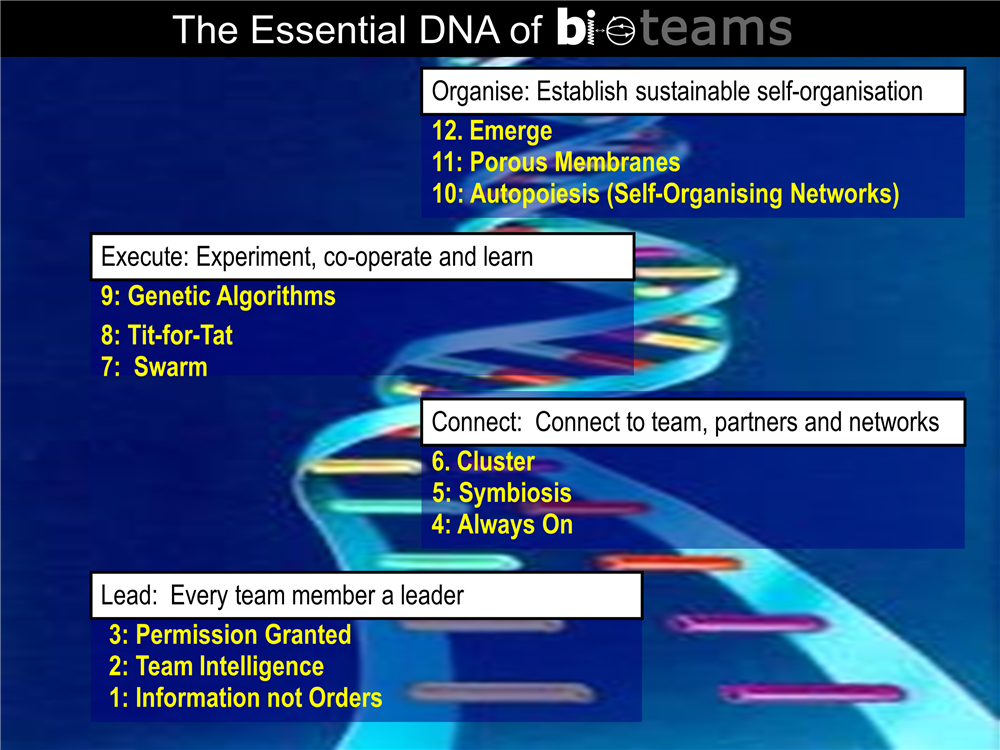
Bioteams is structured around 4 levels of team maturity (“zones”) each of which operate around 3 guiding principles (“rules”) as shown in the diagram.

There is also a Tedx talk and a bioteams book, both by Ken Thompson.

Keeping Virtual Teams Focused In The Pandemic Era

Well, a-lot has changed in the last few months. I don’t want to be cliched by saying this, but we are now officially living in ‘unprecedented’ and dynamic times. Economies have tumbled, organisations that relied on open office spaces and hot desking as modes of productivity have switched entirely to distributed and virtual working from home. Not to forget, other words in the mainstream have surfaced with strong degrees of truth, such as the fact that the need to adapt and pivot business models is more important now than ever! Re-inventing the value chain within executive teams now occur virtually, involve everyone in the organisation and virtual meeting toll Zoom has definitely inherited some great PR, user adoption and a booming share price as a result!

Continue reading “Keeping Virtual Teams Focused In The Pandemic Era”

Nurturing And Motivating Virtual Teams In Uncertain Environments

The world is currently facing new challenges and the impacts of potential global pandemics are shaking fundamental working paradigms that contributed to and engineered economic success in the past. Companies are being forced to look at ways to support their workers through virtual technologies that foster remote working and collaborative project engagements in distributed, non physical environments. The problem is that the future of work is not easily comprehensible or transmissible amidst the ranks of leadership teams and identifying how an organisations productivity, employee engagement, cultural diversity and unity is improved in virtual settings forms part of the resistance against moving to a complete virtual team model – despite its benefits. With the Bioteaming manifesto now reaching fifteen years since conception, it is now relevant to revisit what fundamental elements makes virtual communities and distributed teams sustainable and committed to cohesion and success.

Continue reading “Nurturing And Motivating Virtual Teams In Uncertain Environments”

Collective Intelligence For Teams Inspired From Nature

Whilst it’s true that the rise Artificial Intelligence threatens industries and jobs alike, it also presents an opportunity for humans and teams to embrace the new paradigm by staying one step ahead and making themselves smarter and more capable in harnessing collective intelligence. The term collective intelligence refers to the resulting knowledge or wisdom that ensues when many agents or individuals are involved in a group and where this type of ‘intelligence’ cannot exist through an individual endeavour. It is therefore important that in the face of tectonic shifts in technology and the rise of intelligent machines coupled with the threat of automation; teams and humans embrace a form of ‘swarming’ in order to not only future proof themselves but create the right type of environment to achieve outcomes that could not be reached through individual pursuits. In this article, I refer to various examples of how Nature’s team achieve this ‘swarm intelligence’ and appropriate how these can be achieved in the organisational setting through Bioteaming.

Continue reading “Collective Intelligence For Teams Inspired From Nature”

Customer Intelligence and Teamwork Drive Innovation

Innovation happens in many places and has many faces. Enterprises are required to nurture internal processes that work in sync like ecosystems to encourage front line intelligence to feed ideas through to management so that services, products, processes and teamwork ensues collaboratively to deliver benefits to the Value Chain. This requires effective team work and a supporting methodology that aims to treat your team more like an agile soccer team if you think about it so that anyone can effectively take control of the ball and score the goal.

In the book “Competing Against Luck: The Story of Innovation and Customer Choice” by Harvard Business School professor Clayton Christensen; the core concept of the “Job To Be Done” theory is introduced which is hugely relevant for enterprises wanting to leverage collaborative team work in creating value. The theory stresses that in order to drive organisational product, service and process excellence; we need to focus on alleviating the forces of anxiety, inertia, substitution and resistance across both the customer and employee value chain. Christensen articulates a mechanism to achieve this by firstly creating “specs” that define what outcomes and values are required in order to lead to customers or employees firing old methods, solutions, products and services and adopting new ones. In doing so, the product development team (as an example of a department vested with solving consumer problems) will be satisfied as they have induced consumer adoption either by bringing non-consumption into consuming contexts or working on incremental product and service innovation. Christensen states that “The circumstance is fundamental to defining the job (and finding a solution for it), because the nature of the progress desired will always be strongly influenced by the circumstance”.
This is important as traditionally, managers usually follow one of four primary organising principals in their innovation quest (or some composite therefore) being product attributes, customer characteristics, trends and/or competitive response. The challenge here is that these are not bad or wrong but they are essentially sampling of the most common and are insufficient and therefore not predictive of customer behaviours. In this article, I allude to how the Bioteaming action rules across the Organization, Execution and Connectivity Zone facilitates the dynamics required to solve the ‘job to be done’.

Continue reading “Customer Intelligence and Teamwork Drive Innovation”

Communication Frameworks For Virtual Teams Inspired From Nature

I previously wrote about the most effective communication methodology using pheromone messaging inspired from Nature to identify and augment a robust, team focused unified collaboration system here. In a followup article, I write about how online collaboration tools such as Slack and Microsoft Teams embody the tenets of the pheromone messaging system that Nature has employed to foster effective collaboration and teamwork within their environment. The integration of these virtual collaboration tools leads to the incubation of high performing virtual teams. Through simple changes in mindset and a reconfiguration of existing protocols, organisations can benefit from increased productivity, communication efficiency and trigger serendipitous collaboration within, across and beyond enterprises.

Continue reading “Communication Frameworks For Virtual Teams Inspired From Nature”

Creating Effective Team Communication Systems

Project and enterprise teams across all organisation types are perpetually exposed to a stream of information flows that ebb the natural tempo of processes, policies, system mechanics, codes of conduct and collaboration protocols. These collectively bring upon the information and knowledge economy and the biggest problem here is that everyone is constantly in flux amidst a conundrum of competing batches of instruction, directives and stimuli whilst being overwhelmed with attention deficits. So how do we nurture distributed and collective intelligence in a setting where directives, knowledge and information are constantly fighting for prioritisation? How do teams effectively manage communication and leverage unified communication platforms to drive smart behaviours that lead to focused outcomes? We do this by looking at how Nature has employed the oldest and most evolved form of biological signalling, using chemicals to communicate through smell and taste, but appropriating it for the organisational context.

Continue reading “Creating Effective Team Communication Systems”

Competition and Collaboration Creates High Performing Teams

Many of us have heard the story about the classical race between the tortoise and hare but did you know that there is a version 2.0 of that metaphor? In essence, there was a re-match as the rabbit wanted to prove that being the fastest and ergonomically conducive animal, it would win the second race. Here, the tortoise was obviously left behind but the hare came to a major roadblock in their race track i.e. the bank of a river. How could it possibly transcend this obstacle when it has no mechanics to swim and isn’t designed by Nature to even glide over water? The tortoise eventually caught up and in seeing the hare; offered to carry the hare on its back so that they could both cross the river bank and reach the finish line together!

Continue reading “Competition and Collaboration Creates High Performing Teams”

How To Optimise Team Size In Uncertain Environments

Image Source: Wolf Pack Explains ‘Alpha’ Behavior

The law of requisite variety (a term originally rooted as the first law of cybernetics) states that “If a system is to be stable, the number of states of its control mechanism must be greater than or equal to the number of states in the system being controlled” . In enterprise contexts, this means that that teams and organisations need to nurture their ability to handle dynamic and complex changes stemming from the external environment and have enough structured capacity to react with collective resources in the face of these stimuli so as to not fail and become a ‘un-viable system’.

Continue reading “How To Optimise Team Size In Uncertain Environments”