A bumble bee in flight over long grass

Bioteams

High Performing Teams and Improved Collaboration through Biomimicry

Topic

Collaboration

26 articles.

Bioteams blog relaunches with free download of The Bioteaming Manifesto
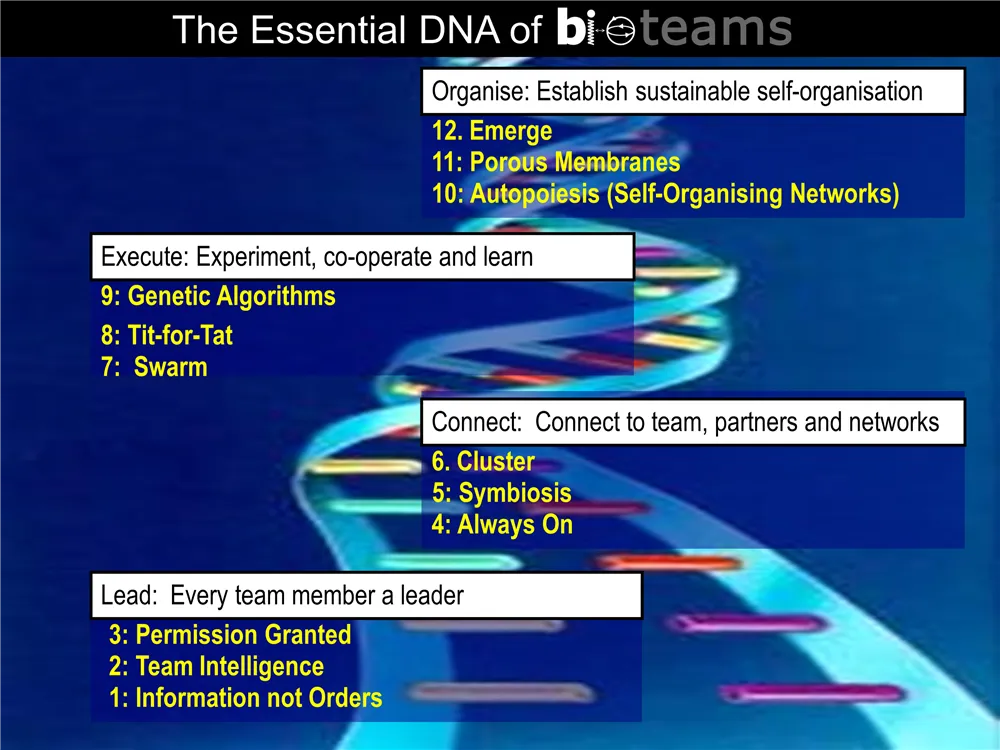
The Essential DNA of Bioteams: a DNA helix labelled with four zones — Lead, Connect, Execute and Organise — each listing three of the twelve bioteam rules, from 'Information not Orders' through to 'Emerge'.

This blog focusses on the bioteams concept – more effective teams based on nature’s proven models. If you would like a detailed overview of bioteams you can request a free copy of the 33-page Bioteaming Manifesto here.

The Bioteaming Manifesto has been downloaded 20,000 times over the last 15 years and is a very popular resource for anyone interested in the important discipline of developing and sustaining High Performing Teams.

Bioteams is structured around 4 levels of team maturity (“zones”) each of which operate around 3 guiding principles (“rules”) as shown in the diagram.

Continue readingBioteams blog relaunches with free download of The Bioteaming Manifesto


Creating Effective Team Communication Systems

A mass of fire ants working together over food on a pale surface.


Project and enterprise teams across all organisation types are perpetually exposed to a stream of information flows that ebb the natural tempo of processes, policies, system mechanics, codes of conduct and collaboration protocols. These collectively bring upon the information and knowledge economy and the biggest problem here is that everyone is constantly in flux amidst a conundrum of competing batches of instruction, directives and stimuli whilst being overwhelmed with attention deficits. So how do we nurture distributed and collective intelligence in a setting where directives, knowledge and information are constantly fighting for prioritisation? How do teams effectively manage communication and leverage unified communication platforms to drive smart behaviours that lead to focused outcomes? We do this by looking at how Nature has employed the oldest and most evolved form of biological signalling, using chemicals to communicate through smell and taste, but appropriating it for the organisational context.

Continue readingCreating Effective Team Communication Systems

Competition and Collaboration Creates High Performing Teams

A lion walking through dry grass flanked by two hyenas.


Many of us have heard the story about the classical race between the tortoise and hare but did you know that there is a version 2.0 of that metaphor? In essence, there was a re-match as the rabbit wanted to prove that being the fastest and ergonomically conducive animal, it would win the second race. Here, the tortoise was obviously left behind but the hare came to a major roadblock in their race track i.e. the bank of a river. How could it possibly transcend this obstacle when it has no mechanics to swim and isn’t designed by Nature to even glide over water? The tortoise eventually caught up and in seeing the hare; offered to carry the hare on its back so that they could both cross the river bank and reach the finish line together!

Continue readingCompetition and Collaboration Creates High Performing Teams

The Prisoners Dilemma, Trust, Cooperation and Effective Teams

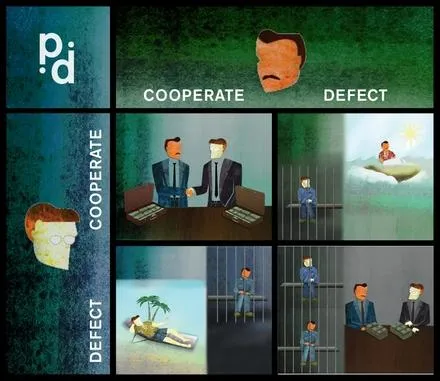
A two by two illustration of the prisoner’s dilemma: both cooperating, both defecting, and the two mixed outcomes, drawn as scenes of a handshake, a beach, and a prison cell.

Image Source: Chalkdust Magazine
I have been reading Lord Sacks daily thoughts “Celebrating Life” and was impressed by his piece on “The Prisoners Dilemma”. The Dilemma in a nutshell is that 2 prisoners are given the chance to do a deal and betray each other. 

Lord Sacks is the UK’s chief Rabbi and highlights one vital aspect of the dilemma which I had not previously paid enough attention to – the fact that the two prisoners are not allowed to speak to each other!

Continue readingThe Prisoners Dilemma, Trust, Cooperation and Effective Teams

The Superintelligent Organization: Create total competitive advantage?

I have been studying one of the most highly regarded books on the future of AI (Artificial Intelligence), “Superintelligence – paths, dangers, strategies” by Nick Bostrom. Bostrom meticulously reviews the five most likely paths to “superintelligence” which he defines “as any intellect that greatly exceeds the cognitive performance of (individual) humans in virtually all domains of interest.”

One of Bostrom’s conclusions is totally unexpected and requires immediate consideration within today’s major organizations and enterprises!

Continue readingThe Superintelligent Organization: Create total competitive advantage?

C3: a new approach to Collaborative Project Management

Most approaches to project management concentrate on the tasks which need to be successfully completed to achieve the project goal. Important as this is, it is at most only half of the story of successful project management. The C3 approach addresses the hidden side of project management – the people-collaboration-end-result perspective and is also a powerful tool for conducting a quick project healthcheck.

Continue readingC3: a new approach to Collaborative Project Management

All you ever learned about meetings is wrong

I have been piloting a radically different approach to meetings which I am calling “Egoless Meetings” which addresses three popular unwritten rules about good meeting practices which are unfortunately totally wrong. RULE 1 is that everybody gets to speak. RULE 2 is that discussions in themselves can be useful. RULE 3 is that when you meet you must work as a team not as individuals.

Continue readingAll you ever learned about meetings is wrong

Is your collaboration SAFE: a simple model for collaborative viability

Most collaborative ventures don’t turn out quite the way we envisage. It would be great if we could determine in advance if a particular collaborative project or joint venture will be worth the required investment. Here is a simple way you can assess the merits of any collaborative endeavour BEFORE you invest time, effort and money in failing to make it work.

Continue readingIs your collaboration SAFE: a simple model for collaborative viability

The Virtually Networked Enterprise: Letting small fish act big

In How To Innovate And Create New Business Opportunities When You Are A Small Fish: Here Comes The VEN, Robin Good and Ken Thompson argue that when you are a small fish, it may appear pretty difficult, if not altogether out of your reach, to be able to “network up” with other small firms to provide higher value services to major clients. But is it a real physical limitation or is it just that small companies lack a proven and effective business collaboration model – The Virtual Enterprise Network (VEN)?

Continue readingThe Virtually Networked Enterprise: Letting small fish act big