A bumble bee in flight over long grass

Bioteams

High Performing Teams and Improved Collaboration through Biomimicry

Page 10 of 10

All articles

Bioteams Part 3: The Team Execution Zone

This article is the third in a four-part series which describes each of the 4 Bioteams Zones, continuing with the Execution Zone.

In a previous article I introduced the second principle of Bioteams – “Bioteams are highly connected virtual networks”. In this article I will introduce a third overarching principle of Bioteams: Bioteams are exceptionally good at taking action, co-operating and learning. I will then introduce the third triad of supporting action rules (rules 7, 8 and 9).

This article was originally published in 2005 by Ken Thompson and Robin Good.

Continue readingBioteams Part 3: The Team Execution Zone

Bioteams Part 2: The Team Connectivity Zone

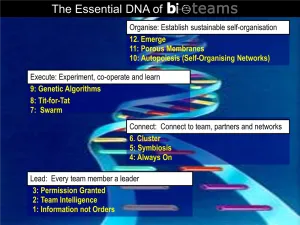
The Essential DNA of Bioteams diagram: four zones of team behaviour, each with three rules.

This article is the second in a four-part series which describes each of the 4 Bioteams Zones, continuing with the Connectivity Zone.

In a previous article I introduced the first principle of Bioteams – “Treat all team members as Leaders (and Adults)”. In this article I will introduce the second overarching principle of Bioteams, “Bioteams are highly connected virtual networks”, and describe the second triad of supporting action rules (rules 4, 5 and 6).

This article was originally published in 2005 by Ken Thompson and Robin Good.

Continue readingBioteams Part 2: The Team Connectivity Zone

Bioteams Part 1: The Team Leadership Zone

This article is the first in a four-part series which describes each of the 4 Bioteams Zones, starting with the  Leadership Zone.

This article was originally published in 2005 by Ken Thompson and Robin Good.

Introduction

In The Bioteaming Manifesto  we argued that traditional teams have key weaknesses and limitations and are now being replaced in organizations by Virtually Networked Teams.
We described the problems these teams face and pointed to critical issues that can make technology both part of the solution and part of the problem.
What emerged as being critical is the realization of Virtually Networked Team’s strong character and dynamic nature, almost as it would be a separate entity from the members making it up.
We  also proposed that this new understanding could be further promoted and made useful to a greater number of people by working around the definition and establishment of a new discipline centred around the study of Bioteams.
Bioteaming is as such a new research area focused on the systematic study of natures’ historically most successful living teams while identifying best methods and approaches to transfer and integrate nature’s best solutions into the daily life of Virtually Networked Teams present handicaps and limitations.

Continue readingBioteams Part 1: The Team Leadership Zone
A Design Framework for Bioteams

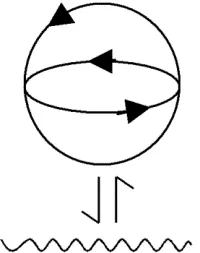
A diagram of a sphere with arrows circling it in two planes, above a downward arrow and a wavy line, representing a living system coupled to its environment.

The Trinity of all Living Systems – A Design Framework for Bioteams. Dr Humberto Maturana and Dr Franciso Varela, 2 Chilean biologist/neuroscientists, in their ground-breaking book “The Tree of Knowledge – The Biological Roots of Human Understanding” [1] suggest a simple but profound model, represented graphically below, which wonderfully captures the essence of living systems.

Continue readingA Design Framework for Bioteams