A bumble bee in flight over long grass

Bioteams

High Performing Teams and Improved Collaboration through Biomimicry

Category

Bioteams and biomimicry

34 articles.

Gaia Theory, Covid and Bioteams

The Earth seen from space, half in shadow.

Gaia Theory, developed by the amazing James Lovelock, contends that our planet is a self-regulating system. An example of this is the incredible ability of nature to keep key variables like temperature, water salinity and CO2 within narrow upper and lower boundaries – seemingly despite whatever else happens!

Most of this happens through continuous small adjustment mechanisms which are effectively invisible to us. However over time the stress on one or more of these variables may become too great for the normal regulation mechanisms to be able to maintain the necessary equilibrium. When this happens Gaia Theory suggests that exceptional adjustments may then occur!

Continue readingGaia Theory, Covid and Bioteams

Collective Intelligence For Teams Inspired From Nature

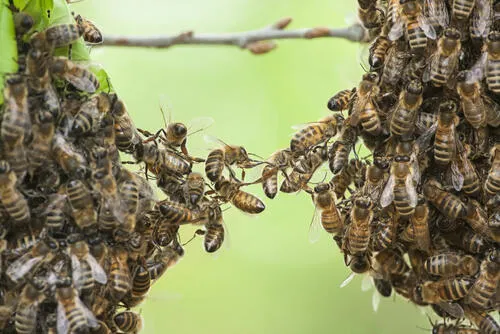
Two swarms of bees meeting from opposite ends of a twig.

Whilst it’s true that the rise Artificial Intelligence threatens industries and jobs alike, it also presents an opportunity for humans and teams to embrace the new paradigm by staying one step ahead and making themselves smarter and more capable in harnessing collective intelligence. The term collective intelligence refers to the resulting knowledge or wisdom that ensues when many agents or individuals are involved in a group and where this type of ‘intelligence’ cannot exist through an individual endeavour. It is therefore important that in the face of tectonic shifts in technology and the rise of intelligent machines coupled with the threat of automation; teams and humans embrace a form of ‘swarming’ in order to not only future proof themselves but create the right type of environment to achieve outcomes that could not be reached through individual pursuits. In this article, I refer to various examples of how Nature’s team achieve this ‘swarm intelligence’ and appropriate how these can be achieved in the organisational setting through Bioteaming.

Continue readingCollective Intelligence For Teams Inspired From Nature

Communication Frameworks For Virtual Teams Inspired From Nature

A man sitting with a laptop on a jetty at sunset, hands behind his head.


I previously wrote about the most effective communication methodology using pheromone messaging inspired from Nature to identify and augment a robust, team focused unified collaboration system here. In a followup article, I write about how online collaboration tools such as Slack and Microsoft Teams embody the tenets of the pheromone messaging system that Nature has employed to foster effective collaboration and teamwork within their environment. The integration of these virtual collaboration tools leads to the incubation of high performing virtual teams. Through simple changes in mindset and a reconfiguration of existing protocols, organisations can benefit from increased productivity, communication efficiency and trigger serendipitous collaboration within, across and beyond enterprises.

Continue readingCommunication Frameworks For Virtual Teams Inspired From Nature

The Prisoners Dilemma, Trust, Cooperation and Effective Teams

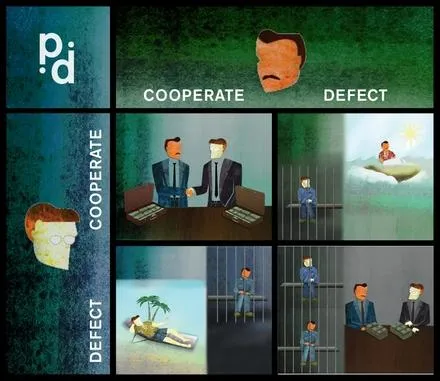
A two by two illustration of the prisoner’s dilemma: both cooperating, both defecting, and the two mixed outcomes, drawn as scenes of a handshake, a beach, and a prison cell.

Image Source: Chalkdust Magazine
I have been reading Lord Sacks daily thoughts “Celebrating Life” and was impressed by his piece on “The Prisoners Dilemma”. The Dilemma in a nutshell is that 2 prisoners are given the chance to do a deal and betray each other. 

Lord Sacks is the UK’s chief Rabbi and highlights one vital aspect of the dilemma which I had not previously paid enough attention to – the fact that the two prisoners are not allowed to speak to each other!

Continue readingThe Prisoners Dilemma, Trust, Cooperation and Effective Teams

Top teams understand the 4 different types of Teamwork in Nature

What do we mean by “Teamwork”? We often talk about Teamwork as if its a singular thing however in nature there are 4 different types – each of which have a very precise meaning. I call these Solowork, Crowdwork, Groupwork and Teamwork itself. An effective team knows how and when to use each type – an ineffective team only uses one!

Continue readingTop teams understand the 4 different types of Teamwork in Nature

Wired Magazine features Bioteams

Are you smarter than a goose? Sure you are — one on one. But when it comes to working efficiently, you and your colleagues can’t touch the gaggle. According to author Ken Thompson, geese and other animals that naturally form groups have a lot to teach us about business. In a theory he calls organizational biomimetics, Thompson lays out the principles underlying nature’s management strategies. So what can you learn from a bird or an ant? Take a gander. Katharine Gammon at Wired Magazine reports.

Continue readingWired Magazine features Bioteams