A bumble bee in flight over long grass

Bioteams

High Performing Teams and Improved Collaboration through Biomimicry

Category

Team performance

24 articles.

Keeping Virtual Teams Focused In The Pandemic Era

A person working at a screen, overlaid with floating chat and video call panels.

Well, a-lot has changed in the last few months. I don’t want to be cliched by saying this, but we are now officially living in ‘unprecedented’ and dynamic times. Economies have tumbled, organisations that relied on open office spaces and hot desking as modes of productivity have switched entirely to distributed and virtual working from home. Not to forget, other words in the mainstream have surfaced with strong degrees of truth, such as the fact that the need to adapt and pivot business models is more important now than ever! Re-inventing the value chain within executive teams now occur virtually, involve everyone in the organisation and virtual meeting toll Zoom has definitely inherited some great PR, user adoption and a booming share price as a result!

Continue readingKeeping Virtual Teams Focused In The Pandemic Era

Nurturing And Motivating Virtual Teams In Uncertain Environments

The world is currently facing new challenges and the impacts of potential global pandemics are shaking fundamental working paradigms that contributed to and engineered economic success in the past. Companies are being forced to look at ways to support their workers through virtual technologies that foster remote working and collaborative project engagements in distributed, non physical environments. The problem is that the future of work is not easily comprehensible or transmissible amidst the ranks of leadership teams and identifying how an organisations productivity, employee engagement, cultural diversity and unity is improved in virtual settings forms part of the resistance against moving to a complete virtual team model – despite its benefits. With the Bioteaming manifesto now reaching fifteen years since conception, it is now relevant to revisit what fundamental elements makes virtual communities and distributed teams sustainable and committed to cohesion and success.

Continue readingNurturing And Motivating Virtual Teams In Uncertain Environments

Customer Intelligence and Teamwork Drive Innovation

A large flock of birds flying in loose formation across a bright sky.

Innovation happens in many places and has many faces. Enterprises are required to nurture internal processes that work in sync like ecosystems to encourage front line intelligence to feed ideas through to management so that services, products, processes and teamwork ensues collaboratively to deliver benefits to the Value Chain. This requires effective team work and a supporting methodology that aims to treat your team more like an agile soccer team if you think about it so that anyone can effectively take control of the ball and score the goal.

In the book “Competing Against Luck: The Story of Innovation and Customer Choice” by Harvard Business School professor Clayton Christensen; the core concept of the “Job To Be Done” theory is introduced which is hugely relevant for enterprises wanting to leverage collaborative team work in creating value. The theory stresses that in order to drive organisational product, service and process excellence; we need to focus on alleviating the forces of anxiety, inertia, substitution and resistance across both the customer and employee value chain. Christensen articulates a mechanism to achieve this by firstly creating “specs” that define what outcomes and values are required in order to lead to customers or employees firing old methods, solutions, products and services and adopting new ones. In doing so, the product development team (as an example of a department vested with solving consumer problems) will be satisfied as they have induced consumer adoption either by bringing non-consumption into consuming contexts or working on incremental product and service innovation. Christensen states that “The circumstance is fundamental to defining the job (and finding a solution for it), because the nature of the progress desired will always be strongly influenced by the circumstance”.
This is important as traditionally, managers usually follow one of four primary organising principals in their innovation quest (or some composite therefore) being product attributes, customer characteristics, trends and/or competitive response. The challenge here is that these are not bad or wrong but they are essentially sampling of the most common and are insufficient and therefore not predictive of customer behaviours. In this article, I allude to how the Bioteaming action rules across the Organization, Execution and Connectivity Zone facilitates the dynamics required to solve the ‘job to be done’.

Continue readingCustomer Intelligence and Teamwork Drive Innovation


Competition and Collaboration Creates High Performing Teams

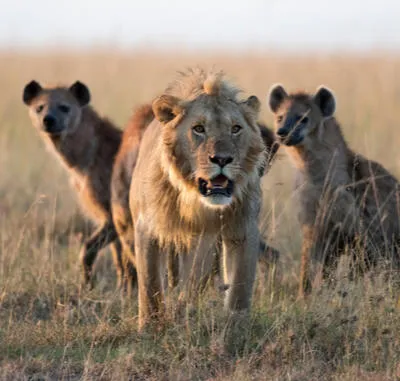
A lion walking through dry grass flanked by two hyenas.


Many of us have heard the story about the classical race between the tortoise and hare but did you know that there is a version 2.0 of that metaphor? In essence, there was a re-match as the rabbit wanted to prove that being the fastest and ergonomically conducive animal, it would win the second race. Here, the tortoise was obviously left behind but the hare came to a major roadblock in their race track i.e. the bank of a river. How could it possibly transcend this obstacle when it has no mechanics to swim and isn’t designed by Nature to even glide over water? The tortoise eventually caught up and in seeing the hare; offered to carry the hare on its back so that they could both cross the river bank and reach the finish line together!

Continue readingCompetition and Collaboration Creates High Performing Teams

How To Optimise Team Size In Uncertain Environments

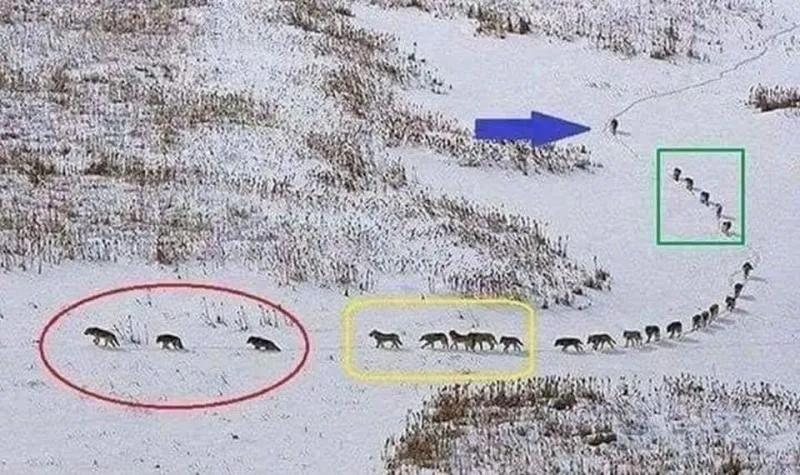
An aerial photograph of a wolf pack crossing snow in single file, with coloured annotations grouping the three animals at the front, the four behind them and a small group at the rear, and an arrow marking the direction of travel.

Image Source: Wolf Pack Explains ‘Alpha’ Behavior

The law of requisite variety (a term originally rooted as the first law of cybernetics) states that “If a system is to be stable, the number of states of its control mechanism must be greater than or equal to the number of states in the system being controlled” . In enterprise contexts, this means that that teams and organisations need to nurture their ability to handle dynamic and complex changes stemming from the external environment and have enough structured capacity to react with collective resources in the face of these stimuli so as to not fail and become a ‘un-viable system’.

Continue readingHow To Optimise Team Size In Uncertain Environments

The evolution of effective team working and how you can accelerate it!

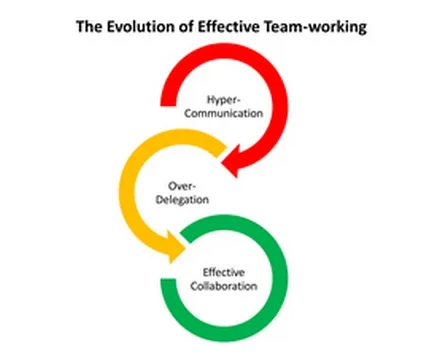
The evolution of effective team working, drawn as three linked circular arrows: hyper-communication, then over-delegation, then effective collaboration.

By observing newly formed and existing teams playing business simulations I have learned some important insights into how team-working ‘evolves’ and offer here some specific ideas on how you might accelerate this evolution in your own organizational teams.
On the road to Effective Team Collaboration there seems to be two intermediate phases of ‘naïve collaboration’ which many teams seem to go through – Hyper-Communication and Over-Delegation.

Continue readingThe evolution of effective team working and how you can accelerate it!

What’s the difference between a promise and a responsibility?

In the recent UK floods we heard a lot about defences failing and phrases being bandied about by engineers and managers such as “a once in a hundred years” event and “could never have been envisaged.” However when I hear these types of explanations it always makes me think instead of the crucial differences between a promise, a responsibility and a guarantee.

Continue readingWhat’s the difference between a promise and a responsibility?

Poor Mental Models fail teams before they even start?

One of the most powerful team exercises is to explore team leaders and team members “mental models” of teams, networks and groups. Mental models are the, often invisible, dictators of what actually happens in a team as opposed to what team leaders would like to happen. Here are some practical techniques for uncovering these “icebergs of the mind” before they sink your teams.

Continue readingPoor Mental Models fail teams before they even start?