A bumble bee in flight over long grass

Bioteams

High Performing Teams and Improved Collaboration through Biomimicry

Category · page 3 of 4

Bioteams and biomimicry

Natures four teamwork systems

What is Teamwork? Although there are many different definitions, in nature the definition of ‘teamwork’ is very precise. There are four different types of “teamwork” in biological teams: Solowork, Crowdwork, Groupwork and Teamwork itself. A bioteam knows how and when to use all four forms – the choice depends on the specific task at hand.

Continue readingNatures four teamwork systems

Dysfunctional teams: bioteam them

There are many ways to analyse dysfunctional teams in organisations such as deficiencies in trust, absence of shared objectives, poor co-operative working practices or inappropriate leadership styles/models. However taking a purely biological perspective opens up exciting new possibilities for really transforming these teams performance.

Continue readingDysfunctional teams: bioteam them

The perfect mobile group communications system: adopt nature’s oldest signalling system

Pheromone-based messaging is the oldest and most evolved form of biological signalling. It uses chemicals to effect communications between animals and insects through smell and taste. There is an excellent opportunity for today’s virtual teams and mobile groups to re-organise the way they use their internet, email, messaging and presence-aware technologies to gain huge benefits from it.

Continue readingThe perfect mobile group communications system: adopt nature’s oldest signalling system

Bioteams Part 3: The Team Execution Zone

This article is the third in a four-part series which describes each of the 4 Bioteams Zones, continuing with the Execution Zone.

In a previous article I introduced the second principle of Bioteams – “Bioteams are highly connected virtual networks”. In this article I will introduce a third overarching principle of Bioteams: Bioteams are exceptionally good at taking action, co-operating and learning. I will then introduce the third triad of supporting action rules (rules 7, 8 and 9).

This article was originally published in 2005 by Ken Thompson and Robin Good.

Continue readingBioteams Part 3: The Team Execution Zone

Bioteams Part 2: The Team Connectivity Zone

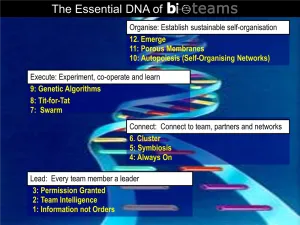
The Essential DNA of Bioteams diagram: four zones of team behaviour, each with three rules.

This article is the second in a four-part series which describes each of the 4 Bioteams Zones, continuing with the Connectivity Zone.

In a previous article I introduced the first principle of Bioteams – “Treat all team members as Leaders (and Adults)”. In this article I will introduce the second overarching principle of Bioteams, “Bioteams are highly connected virtual networks”, and describe the second triad of supporting action rules (rules 4, 5 and 6).

This article was originally published in 2005 by Ken Thompson and Robin Good.

Continue readingBioteams Part 2: The Team Connectivity Zone